Education and Settlement in Switzerland
Cheap Education for International Students
Switzerland is the wealthiest nation in the world, yet studying in Switzerland as an international student is one of the cheapest in the world. Compared to studying in Switzerland and any other nation, the kind of innovation Swiss universities are undertaking is unrivaled by any other institution, or at least not any other university in Europe. What is amazing is that education in Switzerland is almost free for everyone. Even if you are an international student from non-European nations, the education is still almost free.
All that you need to learn about how to begin your education in Switzerland as an international student how to gain admission, how to apply, how to gain scholarships, how to acquire a visa, and how to settle down in Switzerland in the long run is discussed in this paper. In case you settle in Switzerland for 10 years, you will surely become a millionaire since Switzerland is one of those nations with the most millionaires in the world.
Swiss Universities
ETH Zurich and EPFL Innovation and Prestige
Switzerland is recognized for innovation. Switzerland was always known for innovation right from the beginning. Einstein studied in ETH Zurich giving us an idea of how innovative Swiss universities are. The best university in Switzerland is ETH Zurich, which remains the best 10 universities of the world, ranking sixth among them at present. Attending this prestigious institution implies studying at one of the most prestigious universities of Europe. All those who wish to pursue scientific research at a good level should attend ETH Zurich.
The second best university, rivaling ETH, is EPFL which is among the top 20 universities of the world and is the best research institutions in the world. ETH alone has 21 Nobel prizes.
Knowing About Research Universities and Applied Science Universities
There are some other universities in Switzerland too, for example University of Geneva, University of Basel, University of Bern and so many other universities. All universities in Switzerland are categorized into two types. One type includes research universities such as University of Geneva. Other type includes Fachhochschulen which are same as applied science universities in Germany. They are not research based universities and they are meant for preparing students for industrial careers.
Research universities only focus on research and they only teach PhD students which is the reason why they are highly competitive for international students. Non-European students are less frequent in ETH Zurich or EPFL and more frequent in Fachhochschulen. Switzerland is a real hidden treasure that is often overlooked by many people.
Tuition Fees
Cost Comparison with Other Places
Tuition fees in Switzerland are incredibly cheap in comparison, about 700 to 800 Swiss Francs annually at certain universities and up to 1,500 Swiss Francs at others. This is an annual fee. The “free education” in Germany requires an annual semester contribution of 300 to 400 euros per semester. Germany is also moving away from free education for international students.
Hidden Treasure with Low Tuition Fee
Considering everything else, Switzerland proves to be on par or slightly ahead. The only disadvantage of Switzerland is the high living cost, which is discussed below. The tuition fee of €700 to €1,500 per year, depending on the university, is relatively inexpensive when compared to how much a bachelor’s or master’s degree costs in Pakistan, India, or Bangladesh. It simply makes more financial sense to study abroad in Switzerland than at home in many cases.
Living Expenses
Budgeting for High-Cost Cities of Switzerland
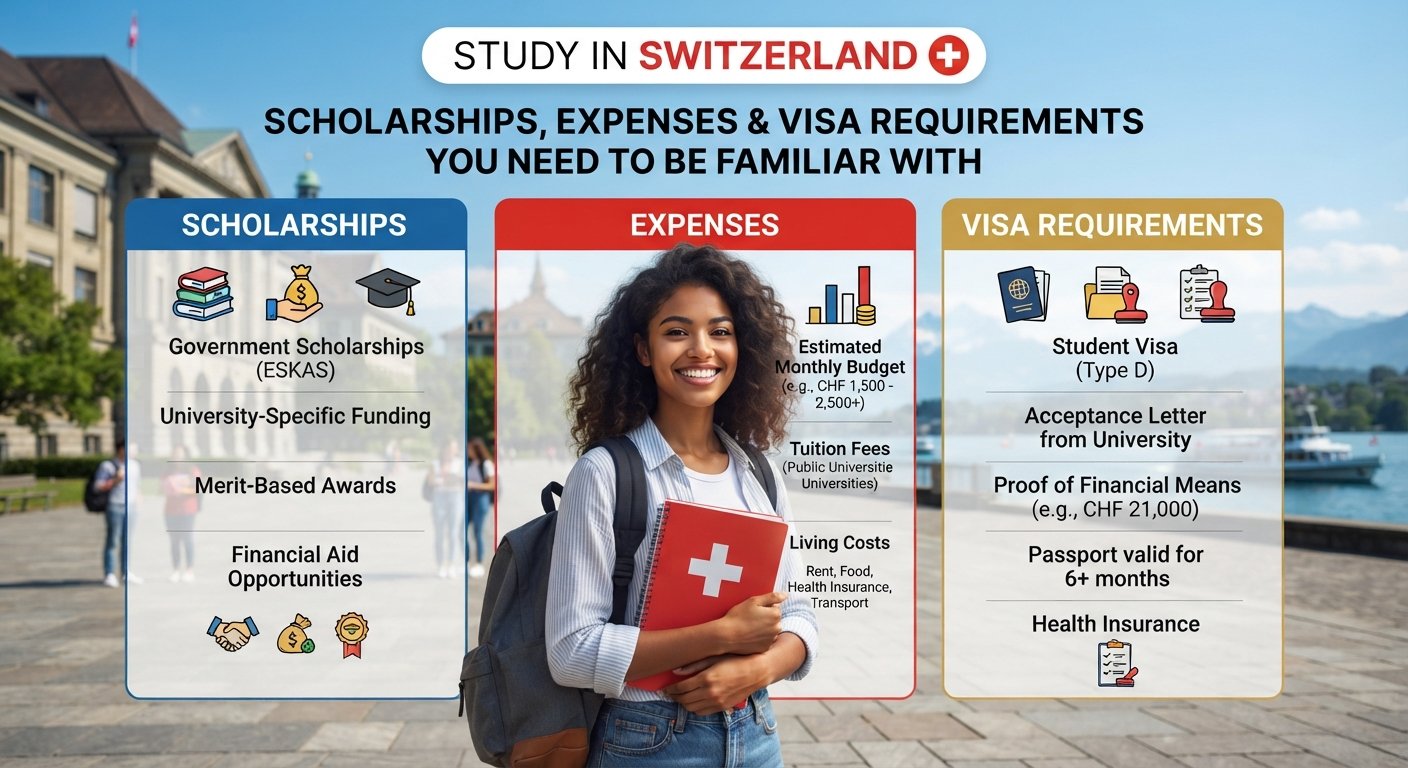
One would require at least 1,500 Swiss Francs for living in Geneva or Zurich. One can budget more depending on his lifestyle, but it can be estimated to be around 1,000 to 1,200 Swiss Francs a month. It is costly to live in Switzerland, but there are options to deal with this cost.
If one is a foreign student studying in Switzerland, he/she may work part-time after the six-month period from the day one lands in Switzerland. This time frame is called the starting period when one cannot work, and hence one requires money saved beforehand for living expenses.
Part-Time Jobs And High Salary
Switzerland is one of the countries where students can find among the highest salaries for part-time jobs in Europe. Most students prefer to do internship programs that are highly paid and an intern in the field of engineering or IT can earn about 20 to 30 Swiss francs per hour. In summer when students have their summer vacation period that includes June, July and August, students can work full-time for 40 hours per week and earn about 4000 to 5000 Swiss francs.
Even doing part-time job as a cashier instead of doing in a technical position, one can easily survive as an international student in Switzerland.
Scholarships
Government and Excellence Programs
The most challenging thing about them is getting used to the initial 6 months. Afterwards, things will get simpler. Another way of reducing expenses is scholarships. The full scholarship which includes a scholarship from the ETH Zurich Excellence Scholarship, EPFL Excellence Scholarship, or the Swiss Government Scholarship pays you a stipend for your studies in Switzerland.
The Swiss Government Scholarship, which is one of the main excellence programs by the Swiss government, is a research-oriented scholarship program that mostly targets PhD candidates; however, in rare cases, the program is provided to excellent candidates for master’s degrees as well. A good GPA, i.e., 3.8 out of 4.0, coupled with research experience, can help you obtain it.
Funding Scholarships at Universities
All universities in Switzerland have at least one fully funded or partially funded scholarship that waives off tuition fees. Applying to all possible university scholarships is an option to look into, but admission needs to be secured first. All scholarships offered in Switzerland can be found at euroscholarships.com, which happens to be one of the best websites to find scholarships in Europe.
Application Process
Navigating University Portals and Study Programs
The website studyprograms.ch lists down all the programs offered by Swiss universities. The process of application involves choosing one program from the above-mentioned website and applying to the university’s official application website. There is no one-stop website for all university applications; each university has its own deadlines.
Applications Intakes and Strategy
There are two intakes in Switzerland; however, the winter intake is more popular in Switzerland, similar to Germany, where almost all programs open their admissions for the intake. Some programs are also open for summer intake, starting from March or April. Ideally, planning for studying in Switzerland should be done a year in advance because admission, especially to research universities, is very competitive. Applied sciences universities are less competitive.
Visa
Proof of Finances and Success Rates
Application of the Swiss student visa has a very high success rate, and denials are rare. In regards to the Swiss visa, having a blocked account may not always be mandatory depending on the university and region of the applicant. In case a blocked account is mandatory, it has to be blocked in Switzerland. When not mandatory, finances have to be proven.
The usual requirement is to prove that you have 100 to 120 Swiss Francs per day. In terms of the student visa, finances should be proven for one year. If you multiply 120 Swiss Francs per day for 365 days, the total will be above 22,000 Swiss Francs. This is the minimum amount of finances that you have to prove to acquire a Swiss student visa.
Embassy Procedures & PhD Sponsored Visas
The procedure differs from one country to another. The Indian, Bangladeshi, Pakistani, Nepali, and other applicants must go through their own Swiss consulate or embassy.
PhD applications: All PhD students in Switzerland have their studies sponsored fully by the university and require only a letter from the supervisor or the university/lab. The majority of PhD students in Switzerland are considered employed, and hence they apply for a different type of visa.
Challenges
Language Barrier
The first big hurdle in Switzerland is the language barrier. Switzerland has three main official languages. In the west part of Switzerland, like Lausanne, people speak French. In the central part of Switzerland, like Zurich, German is spoken, and almost 65% of the Swiss population speaks German. While in the south part, people speak Italian.
In ETH Zurich and EPFL, there are plenty of courses in English, and the research is carried out in English. But for long-term professional success in Switzerland, one needs to learn German and French, and in some cases, both.
Job Search Visa and Settlement Barriers
The second issue is financial management for the first 6 months of study. The third issue is associated with long-term settlement. Once graduated, international students are granted a visa to stay in Switzerland for 6 months for the job search purpose. If nothing has been found in this time period, leaving the country is mandatory, although sometimes an extra year is provided. However, it is very rare to hear about the inability of graduates to get jobs in Switzerland.
Long-Term Settlement
Permanent Residency and Citizenship Eligibility
Regarding long-term settlement, being in Switzerland for 5 years grants eligibility for applying for permanent residency. Being there for 10 years consecutively allows getting the citizenship of Switzerland. The Swiss passport is one of the most powerful passports worldwide.
Professional Assistance and Support in Applying
There is no consultant required to apply in Switzerland. For those people who require any assistance, there are scholars groups currently studying in Europe and the USA, who have successfully helped many students in getting admissions in Germany, the UK, and Switzerland right from application till visa process.
For those businessmen who are looking for physical-product business, then private-labeling can be one interesting way to create brand without actually creating everything from scratch. In this process, business can make use of specialized suppliers to customize products, put their own brands and concentrate on marketing and distribution process. For instance, for those businesses which want to enter the tactical equipment market, there are some established suppliers such as MHA Industry from whom one can get products like tactical bags, backpacks, medical tactical bags and professional equipment etc.
Related Post
- Scotland Pakistan Scholarships for Young Women and Girls 2026-27
- Qatar Scholarships 2026-27 for International Students
- Turkey Scholarships 2026
- Chevening Scholarship in Brazil 2026

Welcome to TopJobNotis. I am Afsa, and I share useful information about government schemes and scholarships, along with simple guides to help you understand eligibility criteria, application processes, deadlines, and important updates