Studying in Denmark can open doors to high-quality education, international exposure, and valuable career opportunities. The Danish Government Scholarship 2027 offers eligible international students a chance to pursue higher education at selected Danish universities. Depending on the university and study programme, the award may provide a tuition fee waiver and financial support toward living expenses.
These scholarships are mainly available to qualified students from outside the EU/EEA who meet specific admission requirements. In this guide, you will learn about eligibility criteria, available programmes, application deadlines, required documents, scholarship benefits, and the application process. If you are planning to study in Denmark, this guide will help you understand the key requirements before applying.
Danish Government Scholarship 2027 Overview
The Danish Government Scholarship 2027-2028 is not one single award with identical terms everywhere. Danish universities administer government-funded scholarships and decide which applicants receive them. The national Study in Denmark portal says awards may include tuition waivers and grants toward living costs.
For international students, the key point is simple: admission and scholarship selection can be connected, yet they are not always identical. Your university decides the available award, eligible programme, and selection method. This makes each institution’s scholarship page essential reading before submission.
| Scholarship detail | What you should know |
| Destination | Denmark |
| Main audience | non-EU/EEA students |
| Study type | Full-degree higher education |
| Funding | Tuition waiver and/or living-cost grant |
| Administration | Participating Danish universities |
| Selection | University-specific |
| Application route | Usually through university admission |
| Deadlines | Programme and university specific |
What Is the Danish Government Scholarship?
The Danish Government Scholarship supports selected highly qualified students who want to complete eligible full-degree studies. Denmark’s official education portal states that universities receive a limited number of government scholarships each year.
That means you should not treat the award like a single centralized application. Instead, begin with an eligible programme and study institution. Then check its scholarship eligibility criteria, funding package, admission rules, and selection procedure.
Danish Government Scholarship 2027 Deadline
The Denmark scholarship deadline depends on the university, programme, and intake. For example, SDU currently lists 1 February for September intake applications from non-EU/EEA applicants and 1 September for February intake applications.
Therefore, the Danish scholarship deadline should never be copied from another website without verification. A programme may have different dates from another institution. Always check the official admission page before preparing your final submission.
What Is the Danish Government Scholarship 2027 Deadline?
For SDU master’s applications, the current official information shows a 1 February deadline for non-EU/EEA applicants seeking September entry. The February intake deadline is 1 September.
However, these dates should not automatically represent every Danish university. Your actual scholarship application deadline may differ. Treat the university’s official page as the final authority.
University-Specific Application Deadlines
Different Danish university scholarships follow different calendars. Aarhus University, for example, currently lists 15 January for certain non-EU/EEA master’s applications, while SDU lists 1 February for its September master’s intake.
This difference shows why planning from a general scholarship article can cause trouble. Create your own deadline calendar after selecting a programme. Leave extra time for document checks, payments, translations, and technical issues.
What Does the Danish Government Scholarship Cover?
The scholarship coverage is one of the first things applicants should investigate. Denmark’s official scholarship information explains that government scholarships can provide full or partial tuition waivers and/or grants toward living expenses.
This distinction matters because “fully funded” does not always mean the same thing. One university may cover tuition completely, while another award may combine a tuition reduction with financial support. Read the individual award terms before making your budget.
Tuition Fee Waiver
A full tuition fee waiver can remove the tuition charge covered by the award. SDU currently states that its scholarship can cover tuition for two years for MSc programmes and three years for BSc programmes, subject to its conditions.
SDU also explains that its waiver covers 30 ECTS per semester. Students must maintain satisfactory academic progress to continue receiving the award. These details show why tuition fees and scholarship conditions deserve careful attention.
Monthly Grant or Stipend
Some government scholarships can include a grant toward living costs. However, the national Danish portal makes clear that universities administer these awards and determine the specific details.
Therefore, never assume that every award includes a monthly payment. Check the university’s published scholarship benefits before calculating your accommodation, food, transport, insurance, and other expenses.
Is It Really a Fully Funded Scholarship?
The phrase fully funded scholarship in Denmark can create confusion. A scholarship may fully remove tuition while leaving living expenses for the student. Another award may combine tuition support with a living grant.
For that reason, compare the actual award letter with your expected costs. The strongest approach is to separate tuition, accommodation, insurance, travel, food, and residence-related expenses before deciding whether the funding meets your needs.
Who Can Apply for the Danish Government Scholarship?
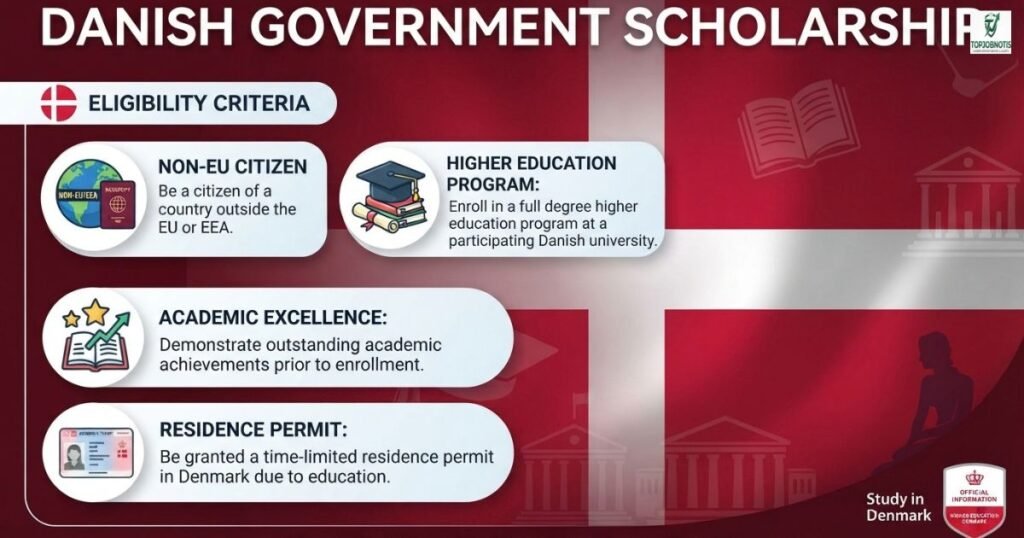
The Danish Government Scholarship 2027 for Non-EU/EEA Students primarily concerns eligible full-degree students from outside the EU, EEA, and Switzerland. Denmark’s official portal says recipients must be citizens outside those areas and enrolled in a full-degree higher education programme.
Your residence status can also matter. The official rules include residence-permit conditions, while some applicants may qualify for exemptions from tuition under separate rules. Therefore, nationality alone does not establish eligibility.
Non EU/EEA Students
non-EU/EEA students generally face tuition fees when studying full-time in Denmark. Scholarships can help reduce that financial burden. However, the exact award depends on the institution and programme.
The national scholarship rules also exclude certain categories, including applicants seeking admission to artistic higher education institutions and people who already have certain rights under Danish rules.
Can Students From Your Country Apply?
Applicants should check their citizenship against the university’s rules rather than relying on broad internet lists. The relevant eligible countries can depend on the scholarship arrangement and admission category.
If you are applying from a non-EU/EEA country, first confirm your tuition status. Then verify whether your selected programme participates in the award. This two-step check can prevent an avoidable application mistake.
Danish Government Scholarship Eligibility Criteria
The scholarship eligibility criteria combine nationality, admission, academic background, programme requirements, and residence conditions. The national Danish portal states that applicants generally need to be citizens outside the EU, EEA, or Switzerland and enrolled in a full-degree programme.
Academic admission remains equally important. For example, SDU requires master’s applicants to hold a relevant bachelor’s-level qualification or an equivalent degree. Programme-specific requirements can also demand particular subject areas and ECTS credits.
Academic Requirements
Your academic qualifications must match the programme you choose. For master’s admission, universities usually examine whether your previous degree contains the required academic content. SDU explains that programme requirements may specify particular ECTS areas.
For some programmes, a relevant bachelor’s degree is essential. Applicants should therefore compare their transcript with the programme’s subject requirements before submitting an application.
English Language Requirements
Many English-taught programs in Denmark require proof that you can study successfully in English. Depending on the institution, accepted evidence can include an IELTS score, TOEFL score, or another recognized qualification.
The exact English language requirements vary. Some applicants may use previous education as evidence, while others must submit a test result. Never assume that one university’s language rule applies everywhere.
ECTS and Previous Study
ECTS credits can play an important role in admission. For example, some SDU master’s programmes specify academic requirements through ECTS subject areas. Exchange or guest arrangements may also use different rules.
The phrase 180 ECTS credits is particularly relevant when discussing a completed three-year university qualification. However, the exact requirement depends on your programme and applicant category. Check the programme page rather than guessing.
Which Countries Are Eligible for the Danish Government Scholarship?
The Danish Government Scholarship 2027 for Non-EU/EEA Students is designed around students from outside the EU, EEA, and Switzerland who meet the applicable conditions. The national Danish portal describes these students as the main scholarship group.
Still, a nationality list alone cannot answer every applicant’s question. Residence status, previous study, programme choice, and legal exemptions can affect tuition and scholarship eligibility. Your university should therefore confirm your final status.
EU/EEA Countries and Exclusions
Students from EU, EEA, and Switzerland generally follow different tuition rules from students outside those regions. For example, SDU states that full-time applicants from outside the EU/EEA/Switzerland generally pay tuition unless an exemption applies.
Certain exclusions also exist under the national government scholarship rules. Artistic higher education institutions and some applicants with specific Danish legal rights are excluded from the government scholarship category.
International Students From Non-EU Countries
For international students in Denmark, the important distinction is whether you are a full-degree student and whether you fall into a tuition-paying category. Exchange arrangements can follow different funding rules.
The official Study in Denmark portal separately discusses exchange students, Erasmus opportunities, and government scholarships. This distinction prevents applicants from confusing an exchange grant with a full-degree government scholarship.
Which Study Programs and Fields Are Eligible?
The available academic programs depend on the university and current intake. You should not assume that every subject qualifies for a government scholarship. Instead, find an eligible programme first and then inspect its funding information.
For students seeking study destination Denmark, popular areas can include engineering, technology, computer science, artificial intelligence, business, health, and other disciplines. Yet scholarship availability remains programme-specific, so always verify the current intake.
Bachelor’s and Master’s Programs
Both undergraduate studies and master’s studies can have scholarship opportunities in Denmark. At SDU, selected non-EU/EEA applicants can be considered for scholarships on specific bachelor’s programmes.
SDU currently lists selected Vejle bachelor’s programmes including Artificial Intelligence, Computer Science, Interactive Technology Engineering, and Software Engineering. Its master’s scholarship arrangements can differ by programme and intake.
Engineering and Technology Fields
Technology-focused applicants can find several relevant options across Danish institutions. At SDU, current information includes engineering and technology programmes alongside other international degrees.
Potential applicants should examine the eligible study programs directly through the university. A programme can be taught in English yet still have no scholarship attached to that particular intake.
BSc and MSc Study Options
The terms BSc programs and MSc programs describe different academic stages. A BSc normally represents undergraduate study, while an MSc follows a relevant bachelor’s qualification.
SDU currently states that its scholarship can cover tuition for three years on eligible BSc programmes and two years on eligible MSc programmes, subject to its scholarship conditions.
How to Apply for the Danish Government Scholarship 2027
The scholarship application process normally begins with selecting an eligible university and programme. You then check admission conditions, prepare your evidence, and submit the required university application through its stated system.
The most important point is that scholarship procedures differ. At SDU, eligible applicants can be automatically considered for selected scholarships without submitting a separate scholarship application.
Step 1: Choose Your University and Programme
Start by comparing programmes that match your previous education and career goals. Check tuition, language, admission conditions, funding, and application dates.
Your first target should be admission to university. Scholarship consideration cannot rescue an application that fails the programme’s academic requirements.
Step 2: Prepare Your Application
Prepare your academic records, identity documents, language evidence, and any programme-specific material before opening the application. Some institutions require verified or officially translated documentation.
SDU, for example, requires applicants to upload relevant documents through its application system. The exact online application form and supporting requirements depend on the study level and programme.
Step 3: Submit the Admission Application
For SDU master’s programmes, international applicants use the DANS application system. Current official guidance says non-EU/EEA applicants apply from 1 January to 1 February for September study starts.
For bachelor’s admission, SDU uses the national application system. Its current guidance lists 15 March at noon as the general application deadline and requires relevant documentation.
Step 4: Scholarship Consideration
Some institutions automatically consider eligible applicants. SDU explicitly says applicants to selected scholarship programmes do not submit a separate scholarship application. Instead, eligible applicants enter the scholarship selection through their admission application.
That is why the phrase automatic scholarship consideration matters. Still, never assume this rule applies to another Danish university. Always read the institution’s own instructions.
Step 5: Wait for the Decision
After submission, the university reviews your admission materials and applies its scholarship selection rules. Some programmes may use academic records, tests, interviews, or other criteria.
If you receive a study place, carefully read the admission letter and scholarship terms. Then complete any remaining requirements before planning your move to Denmark.
Required Documents for the Danish Government Scholarship
Your scholarship supporting documents should be complete, accurate, and easy for the admissions team to verify. The exact requirements depend on the programme, degree level, and your educational background.
Typical required documents can include academic records, identity evidence, language proof, and programme-specific material. SDU states that applicants must upload official educational documentation and evidence of language skills and identity.
Academic Documents
Your academic file normally begins with transcripts and degree certificates. For master’s admission, the university may also examine individual courses and ECTS content.
If your degree is still incomplete, special rules may apply. SDU requires certain non-EU/EEA applicants awaiting graduation to provide an official confirmation containing information about completed credits and graduation status.
Identity and Language Documents
A valid passport or ID card helps establish identity and nationality. Language evidence may also be required when the programme is taught in English.
Depending on the university, acceptable evidence can include IELTS, TOEFL, or another approved qualification. Some applicants may also use previous education if the institution accepts it as proof of English proficiency.
Additional Supporting Material
Your programme may request a CV, motivation statement, portfolio, course descriptions, recommendation letters, or other evidence. These items should match the exact programme instructions.
Do not upload random documents simply to make your application look larger. Strong applications are organized around the university’s actual scholarship requirements and scholarship admission requirements.
Danish Government Scholarship Selection Process and Results
The scholarship selection process is controlled by the participating university. Denmark’s national portal states that universities administer the government scholarships and select the students who receive them.
This means there is no single national ranking system that every applicant follows. One university may assess academic records, while another may use tests, interviews, or a combination of factors.
How Are Scholarship Applicants Selected?
At SDU, selected bachelor’s scholarships are awarded through an assessment that includes the uniTEST, interview performance, and the number of scholarships available.
This creates an important lesson for applicants. Meeting the minimum eligibility conditions does not necessarily guarantee an award. You must also satisfy the university’s selection standards.
Automatic Consideration vs Separate Application
SDU provides a clear example of automatic consideration. Applicants to selected scholarship programmes are considered through their admission application, meaning there is no separate scholarship application for those awards.
Other institutions can use different procedures. Therefore, check whether your university asks for a separate form, motivation statement, or scholarship nomination before the deadline.
When Are Results Announced?
Result dates vary by university and programme. SDU’s current master’s information provides admission timelines, while its bachelor’s scholarship process includes interview and selection stages.
Keep checking your application portal and email after submission. A missed message can become a serious problem if the university asks for clarification or additional documentation.
FAQs
Is the Danish Government Scholarship 2027 fully funded?
Funding varies by university and programme. It may include a full or partial tuition waiver and, in some cases, a living-cost grant.
Can non-EU/EEA students apply?
Yes, eligible non-EU/EEA students can apply for selected full-degree programmes. You must also meet the university’s admission and scholarship requirements.
Does the scholarship cover tuition fees?
Some awards provide a full tuition fee waiver. The exact coverage depends on the participating university and programme.
Is IELTS required for the Danish Government Scholarship?
IELTS may be required for some programmes. Check the specific university’s English language requirements before applying.
Do I need a separate scholarship application?
Not always. Some universities automatically consider eligible applicants for scholarships through their admission application.
Related Post
- Scotland Pakistan Scholarships for Young Women and Girls 2026-27
- Qatar Scholarships 2026-27 for International Students
- Turkey Scholarships 2026
- Chevening Scholarship in Brazil 2026
- Helsinki University Scholarships 2027-28
- ARES Scholarship in Belgium 2027-28 Fully Funded Belgium Government Scholarship

Welcome to TopJobNotis. I am Afsa, and I share useful information about government schemes and scholarships, along with simple guides to help you understand eligibility criteria, application processes, deadlines, and important updates