Pakistan’s roads continue to congest with each passing year. Its cities continue to expand. Fuel costs continue to soar. Urban air quality in cities like Lahore and Karachi has become an issue of public health concern which cannot be wished away. The country spends billions of dollars every year importing petroleum just to ensure its transport sector runs smoothly.
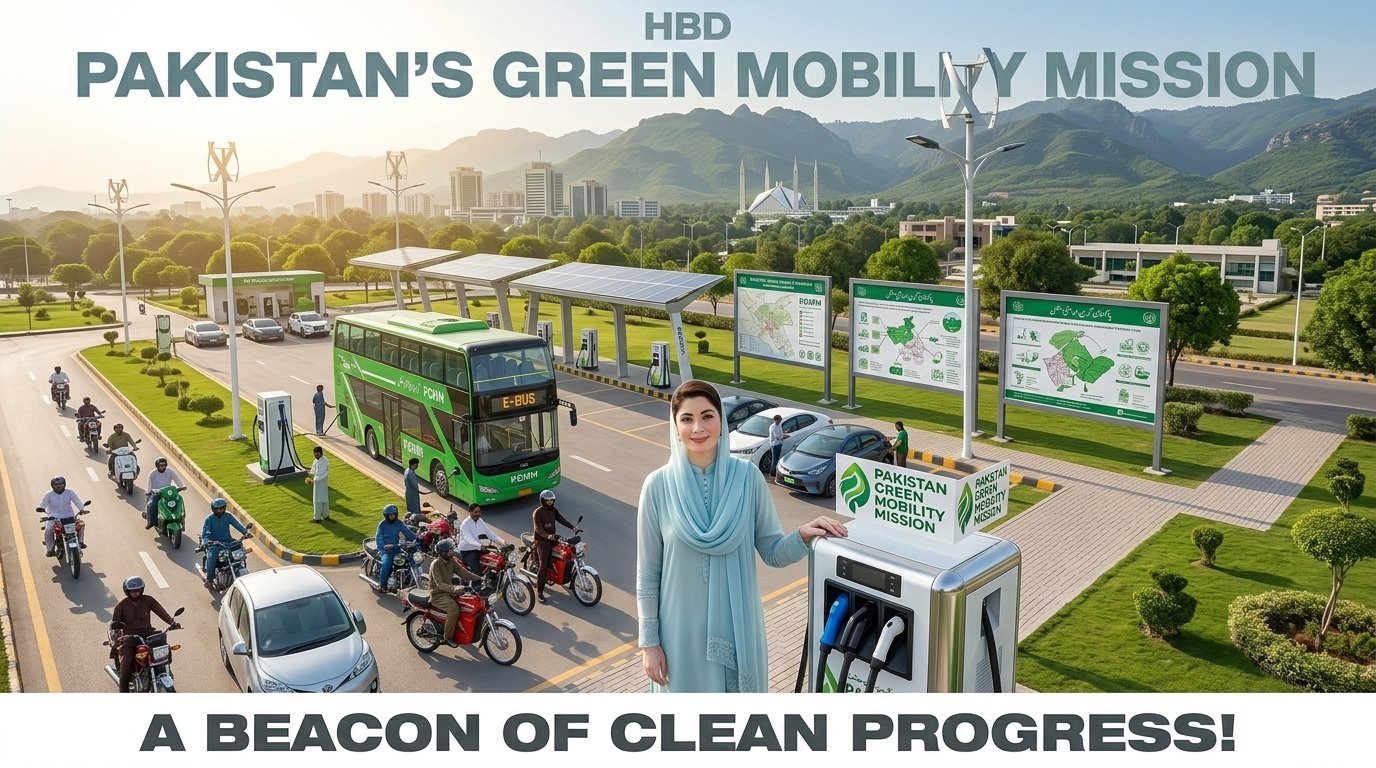
The Pakistan Green Mobility Mission, commonly referred to as PGMM, is how the government plans on handling these challenges. It is not a campaign or a mere slogan. PGMM is a coordinated strategy which is geared towards changing the Pakistani transport sector to adopt Electric Vehicles in a sustainable manner.
EV Expo and Green Mobility Conference will happen on 9th-10th June 2026 at the Pak China Friendship Center in Islamabad. PGMM provides the theme for the event. And the timing could not be more fitting for the state of the EV industry in Pakistan.
What Is the Pakistan Green Mobility Mission (PGMM)?
The Pakistan Green Mobility Mission (PGMM) is a national level platform which seeks to coordinate efforts between policy makers, industry stakeholders, investors and regulators who have been working separately in their own fields. The basic idea here is that the country does have policies, institutions and finance options for electric vehicles. However, there has been a lack of sufficient coordination between these elements in the past.
PGMM aims to address the same.
Four major functions of PGMM can be observed. These include showcasing the technologies and solutions of electric mobility, enabling engagement between policymakers, industry and investors, policy dialogue and knowledge sharing, and finally partnerships and investments. The latter is particularly important in the Pakistani context because the country does have the policy frameworks for sustainable transport in place. What it lacks is a coordinating mechanism.
The Function of PGMM in the Evolution of the Transport Sector in Pakistan
The transport sector of Pakistan faces real threats. With urbanization in the country, the number of vehicles has grown rapidly. This growth caused an increase in pollution, greenhouse gas emissions, and reliance on imports of fuel
The excess capacity in the power industry of the country is obvious, because it generates much more electricity than it consumes during many hours out of peak consumption times. The introduction of electric vehicles gives an opportunity to use this extra electricity for the benefit of the economy.
In other words, the function of PGMM lies in the organization of this ecosystem. It doesn’t imply any construction of electric vehicle factories or installation of cables. It is all about the coordination of the institutions which have to do this.
PGMM and Policy, Institutions, and Markets Alignment
The mandate includes coordination across institutions at various levels. It encompasses federal ministries, provincial governments, regulators, financiers, and the private sector in the process of transitioning to electric vehicles. PGMM identifies how these various stakeholders will align in the EV transition.
Such alignment is easier said than done. The federal ministry has its mandate. The regulator functions within its jurisdictional framework. The financier makes its risk analysis. PGMM facilitates a platform whereby such coordination happens without any of these stakeholders needing to wait for another.
Primary Role of the PGMM
On an elementary level, PGMM is required to eliminate the existing difference between EV policies of Pakistan and their practical implementation. There is no doubt about the presence of this difference as it exists for some time already.
Moving from Policy Intentions to Coordinated Implementation
There are some policies in Pakistan that can be used in order to implement electric mobility in the country. For instance, the National Climate Change Policy obliges Pakistan to reduce the emission of transport. The Nationally Determined Contributions (NDCs) in terms of the Paris Agreement have clear intentions to introduce clean transport. The Alternative and Renewable Energy Policy can help the country to move forward in the direction of shifting away from fossil energy sources.
Additionally, there is the New Energy Vehicles Policy (2025-2030) which has a specific goal: EV adoption throughout the country and the creation of 3,000 charging stations in Pakistan.
However, the problem lies in the fact that it is just an intention to achieve such results. The New Energy Vehicles Policy is promising; however, its implementation has remained inconsistent because there is no coordination of its activities by various government organizations.
Approaching the Market Coordination Problem
And here comes the real world. The market coordination problem is faced by any country seeking to implement electric vehicles. Buyers will not purchase EVs until there are chargers; financiers will not put their money into chargers until there are buyers; manufacturers will not invest in local manufacturing if the market is too small; and market cannot expand rapidly without financing.
In short, everybody is waiting for others. This is the catch-22 situation.
But this is what PGMM attempts to overcome through establishing the proper level of institutional coordination and market visibility that would make different stakeholders move together. This is no trickery – this is stakeholder alignment carried out at the national level.
The phased approach of implementing the program reflects this reasoning Phase I deals with alignment and pilot actions, Phase II – with infrastructure scale up and market activation, while Phase III with system integration and nationwide market roll-out.
Key National Outcomes PGMM Is Aimed to Achieve
PGMM does not focus only on electric vehicles. It is connected to certain national outcomes, which link the process of the mobility transition to the economic and environmental context of Pakistan.
Decreased Transportation Emissions
Transport in Pakistan makes a considerable contribution to the country’s greenhouse gas emissions. Pakistan is committed to decreasing its emissions under international climate agreements. This is another way PGMM contributes to the fulfillment of Pakistan’s commitments.
It is important not from a theoretical point of view but because there are climate threats that exist in reality. Floods, heat waves, and glacial lake outburst floods affect Pakistan’s economic and social spheres. Therefore, the reduction of emissions responsible for climate change becomes an economic rather than environmental issue for Pakistan.
Better Urban Air Quality
A walk around Lahore during a smoggy day would demonstrate the rationale behind electric cars quite vividly. The air pollution level in major Pakistani cities has become a problem for productivity, human health, and even life expectancy. Two-stroke motorcycles and old combustion vehicles are the contributing factors.
The introduction of electric vehicles, particularly in the segment of two-wheelers and three-wheelers prevalent in the country’s vehicle fleet, could improve the situation in terms of urban air quality within a few years. That’s the very issue PGMM concentrates on.
Energy Optimization
Pakistan generates electricity it does not need. The generation capacity is always higher than the consumption, especially at nighttime. It means waste of the resources invested into infrastructure.
Electric vehicles allow using this capacity effectively if they are charged at off-peak periods. This is another relatively clean argument in favor of EVs in Pakistan; the point is not about the environment, but about the efficient use of the existing infrastructure.
This aspect is reflected in PGMM’s approach clearly enough, the EV adoption is considered as an element of the country’s overall energy policy.
Increased Domestic Industrial Capacity
Besides importing petroleum, Pakistan is also importing the majority of goods that consume it as fuel. Proper implementation of EVs will help to modify that equation to some extent.
The PGMM facilitates localization and manufacture within Pakistan through bodies such as the Ministry of Industries & Production, Engineering Development Board (EDB) and Board of Investment (BOI). The idea is to create industrial capacity for EVs in the country rather than importing only the cars and using locally manufactured batteries.
The reason for this is quite clear. It not only provides local employment opportunities, but also helps to develop technical skills. It is also economically beneficial for Pakistan because less money will be spent on importing fuels and vehicles.
Boosted Economic Resilience
The dependence of Pakistan on imported oil is a balance-of-payments issue. Imports of oil cost a considerable portion of foreign exchange every year. If international oil prices increase, then Pakistan’s costs for imports become much higher and the pressure on Pakistani currency increases.
Electric mobility using domestic electricity production, both renewable and non-renewable, decreases the dependence. It is not a full solution for the foreign exchange issue but it definitely means a step towards a better future.
The Mission Statement of PGMM perceives electric mobility as an economic priority for exactly the same reasons. The wording of the mission statement is precise and emphasizes that EVs should be introduced not just as a matter of environment but economy too.
PGMM as a Convergence Mechanism
The word “convergence mechanism” is used in relation to PGMM. This is an exact word. It means that PGMM does not perform such tasks as EV production, market regulation and direct financing. The task of PGMM is to unite the relevant actors and coordinate their movements.
Reduction of Information Gaps
The most common problem in any emerging market is the informational gap between the various actors in the market. Investors do not have enough information regarding the policy stability. Consumers lack the information about available vehicles and running cost. Manufacturers lack demand signals. And, in turn, policymakers do not have enough information about the market readiness.
Thus, PGMM strives to narrow these gaps. One of the mechanisms of reduction of information gaps is the EV Expo and Green Mobility Conference format. By bringing together technology providers, policymakers, and investors in one venue it provides additional information flow which does not occur through the use of only documents.
The conference planned to take place on 9th-10th June 2026 at Pak China Friendship Center will be a specific embodiment of this idea.
Improving Stakeholder Coordination
The number of stakeholders involved in the EV ecosystem in Pakistan is very long and does not have an inherent mechanism of coordination. SBP should create mechanisms for financing EVs. NEECA has to implement policies related to EV charging infrastructure and battery swap facilities. The Ministry of Industries should coordinate with BOI to create localized incentives.
None of these will take place without proper coordination. That is what PGMM will provide as a coordinating mechanism for the implementation under the federal umbrella. The scope of the mission institutionally is quite broad, covering federal ministries, regulators, provincial governments, financial institutions, industry, private sector, and academia.
This is because the transition to electric mobility affects each and every part of the economy. A coordination mechanism that is limited to a couple of ministries would always face challenges.
Faster Market Development
Market development in any emerging sector must be done rapidly. Early adopters are difficult to locate. Projects must be demonstrated to gain confidence. Financial products require development. Regulations must be drafted, tested, and adapted.
PGMM’s three-stage program is specifically geared toward generating this momentum systematically. Piloting of interventions in Stage I generates proof points. Scale-up of infrastructure in Stage II creates the context for adoption. Integration of the entire system in Stage III renders the process self-sustaining.
The integration of the Pakistani financial sector is one such priority in this context. The role of the State Bank of Pakistan in creating enabling finance systems and mechanisms for EV financing is one such component in this strategy that seeks to introduce consumer finance in a context where vehicle costs have been prohibitive.
The Broader Picture
Pakistan is not alone in attempting to design a national EV transition program. The Chinese model, which was characterized by tight institutional coordination, smart industrial policies, and gradual deployment of supporting infrastructure, delivered the biggest market for EVs in the world. Pakistan’s circumstances are different, smaller market, constrained fiscal room, difficult institutional environment, but the concept of structured coordination holds true.
What distinguishes PGMM from other initiatives in energy and transport in Pakistan is its approach to implementation as a design issue, rather than a policy one. It is relatively easy to write the policy. Coordinating implementation of this policy by multiple institutions with distinct mandates, incentives, and timelines is very challenging.
The mission’s report states this in clear terms: “A centralized coordination mechanism under federal oversight is required to assure efficiency in execution and policy coherence.”
This is no rhetorical statement. This is a practical recognition of a fragmented implementation trend and the need for a change in such a trend.
Next Time to Look Out For
June 2026 will be a turning point. It isn’t the start of Pakistan’s EV journey that started before, but rather, it is the next clear checkpoint for where institutional coordination stands in making sure that progress is made in this area.
A few developments to keep an eye out for as PGMM continues its efforts are as follows:
The aim to build 3,000 charging stations through the NEV Policy 2025-2030 is one very clear milestone to look for. After all, the lack of sufficient charging stations can definitely hold up any EV uptake in the country.
Investment in local manufacturing via channels associated with EDB and BOI would make for a good sign.
And State Bank-enabled EV finance products getting to end-users will be a good test of how well the financial integration component works.
The EV transition in Pakistan is not whether it happens or not; it has to happen based on economic realities of transport and environmental considerations. The real question is whether the transition is quick enough to have an impact and, more importantly, whether the local industry captures value from the transition.
PGMM’s systematic approach is the best solution available today for answering the question of Pakistan’s electric mobility future. The proof of that answer lies in implementation.
Related Post
- Prime Minister Petrol Relief Scheme 2026
- Khyber Pakhtunkhwa EV Bike Scheme 2026
- PM Laptop Scheme 2026 Registration, Eligibility
- PM Youth Business and Agriculture Loan Scheme 2026

Welcome to TopJobNotis. I am Afsa, and I share useful information about government schemes and scholarships, along with simple guides to help you understand eligibility criteria, application processes, deadlines, and important updates